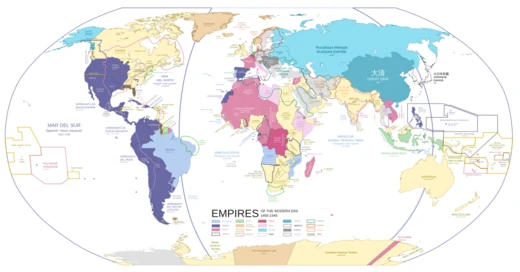
Ming dynasty
Last Han-led imperial dynasty of China, ruled 1368–1644.
The Ming dynasty, officially called the Great Ming, was an imperial dynasty in China that lasted from 1368 to 1644. It began after the Mongol-led Yuan dynasty fell apart. The Ming was the final Chinese imperial dynasty governed by the Han people, who make up the country’s main ethnic group. Even though the main capital, Beijing, was taken in 1644 by a rebellion led by Li Zicheng—who then created the short-lived Shun dynasty—several leftover regimes run by members of the Ming royal family, known together as the Southern Ming, held on until 1662.
The dynasty’s founder, the Hongwu Emperor (who ruled from 1368 to 1398), aimed to build a society of self-sufficient farming villages arranged in a strict, unchanging system. This system was meant to support a permanent class of soldiers for his rule: the empire’s standing army had over one million troops, and the navy’s shipyards in Nanjing were the biggest in the world. He also worked hard to weaken the power of court eunuchs and powerful families not related to him. He gave land to many of his sons across China and tried to guide them using the *Huang-Ming Zuxun*, a set of published dynastic instructions. This plan failed when his teenage successor, the Jianwen Emperor, tried to reduce his uncles’ power. That led to the Jingnan campaign, a revolt that put the Prince of Yan on the throne as the Yongle Emperor in 1402. The Yongle Emperor made Yan a secondary capital and renamed it Beijing, built the Forbidden City, fixed the Grand Canal, and restored the importance of the imperial examinations for choosing officials. He rewarded the eunuchs who had supported him and used them to balance the power of Confucian scholar-bureaucrats. One eunuch, Zheng He, led seven huge voyages of exploration across the Indian Ocean, reaching as far as Arabia and the eastern coasts of Africa. Both the Hongwu and Yongle emperors also expanded the empire’s control into Inner Asia.
The rise of new emperors and different political groups reduced such grand projects. The capture of Emperor Yingzong during the 1449 Tumu Crisis ended them completely. The imperial navy was allowed to fall apart, while forced labor built the Liaodong palisade and connected and strengthened the Great Wall into its modern form. Wide-ranging censuses of the whole empire were taken every ten years, but the desire to avoid labor and taxes, along with the difficulty of storing and reviewing the huge archives in Nanjing, made accurate numbers hard to get. Estimates for the late-Ming population range from 160 to 200 million, but necessary revenues were squeezed from a shrinking number of farmers as more people disappeared from official records or “donated” their lands to tax-exempt eunuchs or temples. The *haijin* laws, meant to protect the coasts from Japanese pirates, instead turned many people into smugglers and pirates themselves.
By the 1500s, the growth of European trade—though limited to islands near Guangzhou, like Macau—brought the Columbian exchange of crops, plants, and animals into China. This introduced chili peppers to Sichuan cooking and highly productive maize and potatoes, which reduced famines and spurred population growth. The rise of Portuguese, Spanish, and Dutch trade created new demand for Chinese products and brought in a huge amount of South American silver. This abundance of precious metal re-monetized the Ming economy, whose paper money had suffered repeated hyperinflation and was no longer trusted. While traditional Confucians opposed such a big role for commerce and the newly rich it created, the unorthodox ideas introduced by Wang Yangming allowed a more accepting attitude. The initially successful reforms of Zhang Juzheng turned devastating when a slowdown in agriculture was caused by the Little Ice Age. The value of silver quickly rose because of a disruption in the supply of imported silver from Spanish and Portuguese sources, making it impossible for Chinese farmers to pay their taxes. Combined with crop failure, floods, and an epidemic, the dynasty collapsed in 1644 as Li Zicheng’s rebel forces entered Beijing. Li then set up the Shun dynasty, but it was soon defeated by the Manchu-led Eight Banner armies of the Qing dynasty, with help from the defecting Ming general Wu Sangui.
**History**
**Founding**
**Revolt and rebel rivalry**
Before the Ming, the Mongol-led Yuan dynasty (1271–1368) ruled. Reasons for the Yuan’s fall include official ethnic discrimination against the Han people, which stirred resentment and rebellion; overtaxation of areas hit hard by inflation; and massive flooding of the Yellow River caused by abandoned irrigation projects. As a result, agriculture and the economy were in ruins, and rebellion broke out among the hundreds of thousands of peasants called to repair the Yellow River’s levees. Several Han groups revolted, including the Red Turbans in 1351. The Red Turbans were linked to the White Lotus, a Buddhist secret society. Zhu Yuanzhang was a penniless peasant and Buddhist monk who joined the Red Turbans in 1352. He soon gained a reputation after marrying the foster daughter of a rebel commander. In 1356, Zhu’s rebel force captured the city of Nanjing, which he later made the capital of the Ming dynasty.
As the Yuan dynasty crumbled, competing rebel groups began fighting for control of the country and the right to start a new dynasty. In 1363, Zhu Yuanzhang eliminated his main rival and leader of the rebel Han faction, Chen Youliang, at the Battle of Lake Poyang—arguably the largest naval battle in history. Known for its bold use of fire ships, Zhu’s force of 200,000 Ming sailors defeated a Han rebel force over three times their size, claimed to be 650,000 strong. The victory destroyed the last opposing rebel faction, leaving Zhu Yuanzhang in uncontested control of the rich Yangtze valley and cementing his power.
- Founded
- 1368
- Collapsed
- 1644
- Founder
- Hongwu Emperor
- Capital
- Beijing (primary), Nanjing
- Nationality
- Chinese (Han-led)
- Known for
- Last Han-ruled imperial dynasty; naval expeditions under Zheng He; construction of the Forbidden City
Lore & Background
The Hongwu Emperor attempted to create a society of self-sufficient rural communities, maintained a standing army exceeding one million troops, and built the world's largest navy dockyards in Nanjing. He also broke the power of court eunuchs and enfeoffed his many sons throughout China, issuing the Huang-Ming Zuxun to guide them. He employed eunuch supporters as a counterweight to Confucian scholar-bureaucrats, and one eunuch, Zheng He, led seven enormous voyages into the Indian Ocean as far as Arabia and eastern Africa. By the 16th century, European trade introduced crops like maize and potatoes, and a massive influx of South American silver re-monetized the economy. However, the Little Ice Age, crop failures, floods, and an epidemic, combined with a disruption in silver supply, led to the dynasty's collapse in 1644 when Li Zicheng's rebels entered Beijing.
Reader's Guide
The Ming dynasty is significant as the last imperial dynasty of China ruled by the Han people, marking a period of Han cultural restoration after Mongol rule. Its early emperors expanded into Inner Asia, built a massive standing army and navy, and undertook ambitious construction projects such as the Forbidden City and the restoration of the Grand Canal. The Ming also saw the voyages of Zheng He, which projected Chinese maritime power across the Indian Ocean. Economically, the dynasty experienced a shift from paper money to silver monetization driven by European trade, and the introduction of New World crops spurred population growth. However, internal administrative challenges, including tax evasion and reliance on forced labor, along with external pressures from Japanese piracy and later Manchu invasion, contributed to its decline. The Ming legacy includes its legal code, the Great Ming Code, and its influence on subsequent Chinese dynastic governance.
Did You Know?
- The Ming dynasty's standing army exceeded one million troops, and its navy dockyards in Nanjing were the largest in the world.
- Zheng He, a eunuch, led seven enormous voyages into the Indian Ocean as far as Arabia and the eastern coasts of Africa.
- The Ming dynasty collapsed in 1644 when Li Zicheng's rebel forces entered Beijing; Li then established the short-lived Shun dynasty.
From Kingdom to Empire: Europe's Shifting Gaze
When European voyagers first made direct contact with Ming China during their early 16th-century voyages, the prevailing assumption in European intellectual circles was that they had encountered a kingdom, not an empire. This initial misclassification reflected a framework in which only the most sprawling, multi-tiered political entities qualified as imperial. The shift away from that assumption did not happen overnight. It was Maximilianus Transylvanus who is credited with being the first to elevate China to imperial status in his writings. Yet even as these scholars made their cases, popular adoption lagged considerably behind. Only by the final decade of the Ming dynasty did an increasing number of Europeans consistently adopt the term 'Chinese Empire.'
Jesuit Bridges: Translating an Empire
The intellectual work of reclassifying Ming China as an empire was carried out largely by Jesuit missionaries and European scholars who sought to map Chinese political concepts onto familiar European categories. Figures such as Matteo Ricci, Álvaro Semedo, Martino Martini, and Philippe Couplet each contributed to constructing the name 'Chinese Empire' by drawing comparisons between European notions of empire and kingdom, translating Chinese political terminology, and building genealogies that linked the Ming court to a broader imperial tradition. Ricci, one of the founding figures of the Jesuit China missions, offered a particularly illuminating analogy: he argued that the name of the empire had remained unchanged since ancient times, even as different ruling families took power—much as the name 'German Empire' would persist regardless of whether the Austrian family or another house held the throne. This framework of 'imperial power transfer' allowed Europeans to see the Ming not as an isolated polity but as the latest chapter in a continuous imperial story stretching back millennia.
The Tribute System as Imperial Proof
Before the Ming dynasty, European knowledge of China was filtered through secondhand accounts, most famously Marco Polo's 13th-century travelogue, which referred to the land as Cathay. It took considerable effort for most Europeans to accept that Cathay and China were one and the same, let alone to grasp the political structure governing it. When direct contact finally came during the early 16th century, the question of how to classify Ming China's political order became urgent. In this arrangement, the emperor occupied the apex of a layered political order, a configuration that resonated with European understandings of imperial authority. This observation gave European intellectuals a concrete, observable mechanism through which to justify calling the Ming realm an empire rather than simply a large kingdom. The tribute system thus became, in the European mind, the empirical backbone of the 'Chinese Empire' concept.
One Empire, Many Dynasties: The Ming in a Continuous Narrative
Traditional Chinese historiography has long conceived of its political history as an unbroken sequence of dynasties, a framework that the Ming dynasty (1368–1644) occupied as one link in a chain stretching back to 221 BC, when China was first unified under a single emperor. Within this narrative, the Ming was not a standalone state but the latest expression of an empire whose identity predated any single ruling house. Juan González de Mendoza made this explicit in the late 16th century, stating in three separate places in his work that the mythical Yellow Emperor had elevated the Chinese kingdom to imperial status, meaning every dynasty since then—including the Ming—was simply a continuation of that original empire. Matteo Ricci reinforced this view through his concept of imperial power transfer, arguing that the empire's name endured even as the ruling family changed.
Frequently Asked Questions
Who is the Ming dynasty?
The Ming dynasty was a Han Chinese imperial regime that governed China from 1368 until its fall in 1644. It rose after the Mongol Yuan dynasty collapsed and stands as the final imperial dynasty led by the Han majority.
What are the Ming dynasty's key powers and achievements?
The Ming is celebrated for Zheng He's massive oceanic treasure fleets, the construction of the Forbidden City, and its role as the last Han-ruled imperial government in Chinese history. Its primary seat of power was Beijing, with Nanjing serving as a secondary capital.
Why is the Ming dynasty important?
It represents the last time the Han majority held the imperial throne, making it a defining chapter in Chinese political identity. Its cultural, military, and naval accomplishments set a benchmark that later dynasties measured themselves against.
Who founded the Ming dynasty?
The Hongwu Emperor, formerly a peasant rebel named Zhu Yuanzhang, established the dynasty in 1368 after defeating Yuan forces. He restructured the bureaucracy and reasserted Han cultural dominance across the empire.
More in Ancient Empires 1-24
Spotted an error? Know more?
This is a living reference — every entry is fact-audited, and reader corrections feed straight into our audit queue. Suggest an edit · See this site's audit record